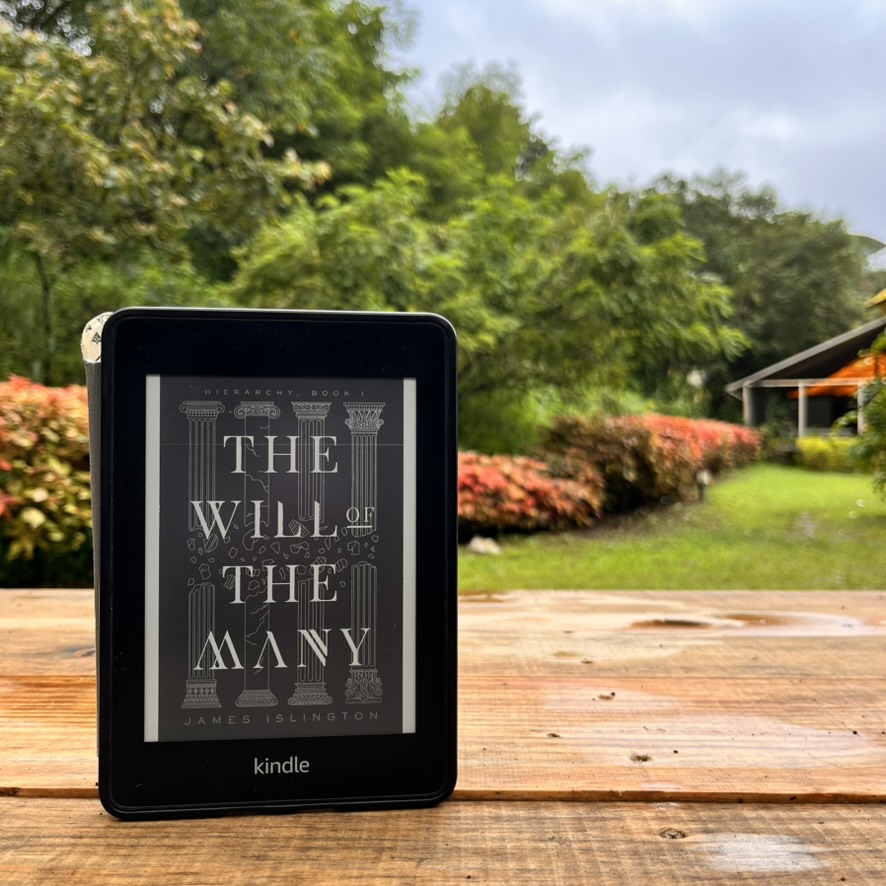
Book 13: The Will of the Many by James Islington
Usually, I don’t read epic fantasy. As someone who has read a plethora of books, I still haven’t read The Lord of the Rings. But the pandemic years changed that a little. In those years, I required to be elsewhere, stay sane, and fantasy helped greatly. Therefore, reading The Will of the Many was a matter of chance and time. None of my friends have read it, and despite SF’s many attempts I am yet to read the Stormlight Archive, so reading this book was destined, perhaps.
Anyhoo.
In the fictional world of Caten, lower classes must cede a portion of their physical and mental will to the upper classes forming a pyramid structure (the Hierarchy) wherein the higher classes are few but powerful due to the number of people below them who give their their Will. The story’s young hero Vis Tellimus has refused to cede his will and is adopted by a Quintus (fifth level) man who sends him to the Catenan Academy to compete with the students and earn top placement in the Hierarchy’s structure while uncovering a pagan-kind-of-bloody mystery that might have killed the Quintus’ brother.
Vis Tellimus’ past plays a huge role in his actions as he’s actually the prince of a former kingdom which was obliterated by the upper class of this ‘pyramid scheme’ of a society. Pun intended. None of this is kept secret from the reader. While navigating the favours of the Hierachy, Vis wants to rise the ranks to avenge his family’s murder and his kingdom’s destruction. On the other hand, the student tests being conducted at the Academy are eerie and deadly to say the least. Vis has to survive them to stay alive and meet his goal.
The world building in the book takes a huge chunk of time. However, it is quite readable. Towards the end, there is a hint of a new kind of interpretation of events, which act as a cliffhanger for the second book The Strength of the Few. The society of Caten tackles the themes of how many people tend to uphold evil structures by simply conceding to those wealthier or more powerful. It also describes the colonisation and genocide of people by supremacists, and the existence of revolutionaries looking to change societal structures. All in all, while this may seem like some young prince hiding his identity and goes to a school to avenge his family, but the themes are quite serious, and some rites are macabre.
Reading this book was a strange, uncomfortable, yet compelling experience. It reflects the world we live in, and then suddenly becomes wildly uncomfortable in its religious rites and mysteries. All in all, it kept me going.
The second book in this Licanius Trilogy comes out on 11 November ’25. I look forward to reading it.
🌟 3.5/5
 amarllyis
Leave a Reply